Hashi Puzzle Tips: 6 Checks That Find the Forced Bridge
Hashi puzzle tips for when you know the rules but get stuck: count neighbours, spot one-short islands, avoid closed groups, recount after every bridge.
Published 4 min read
On this page
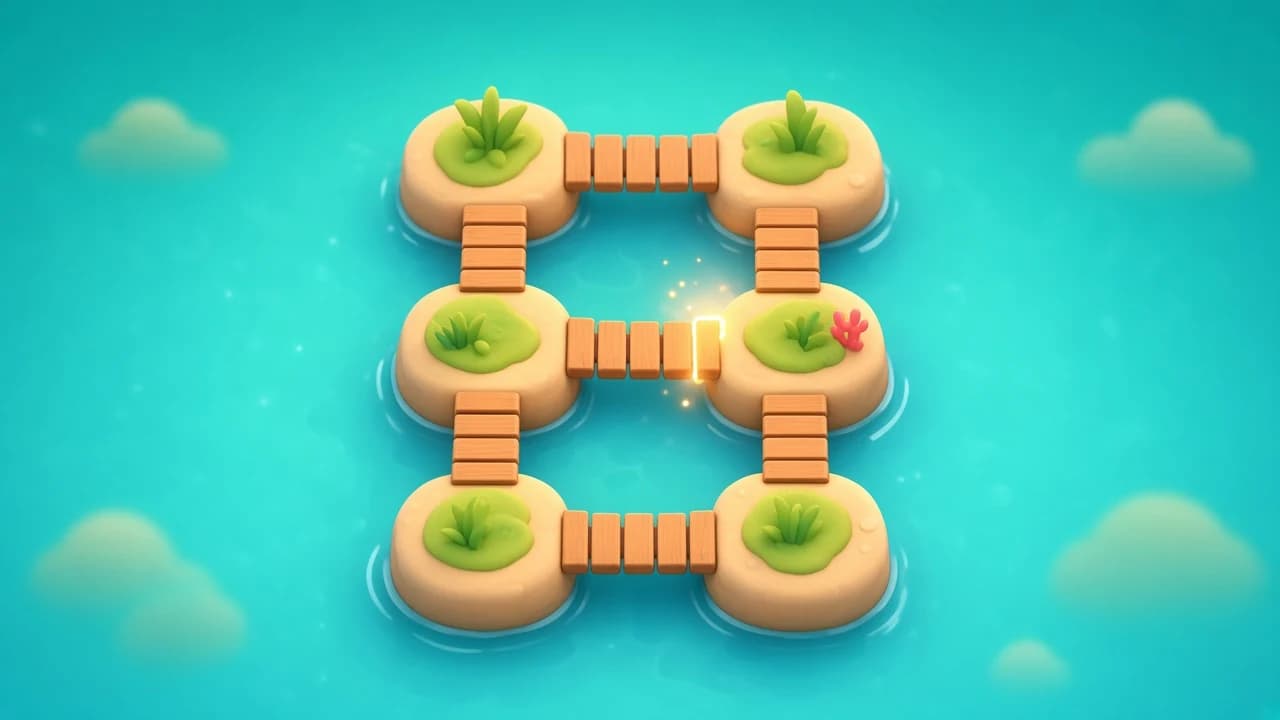
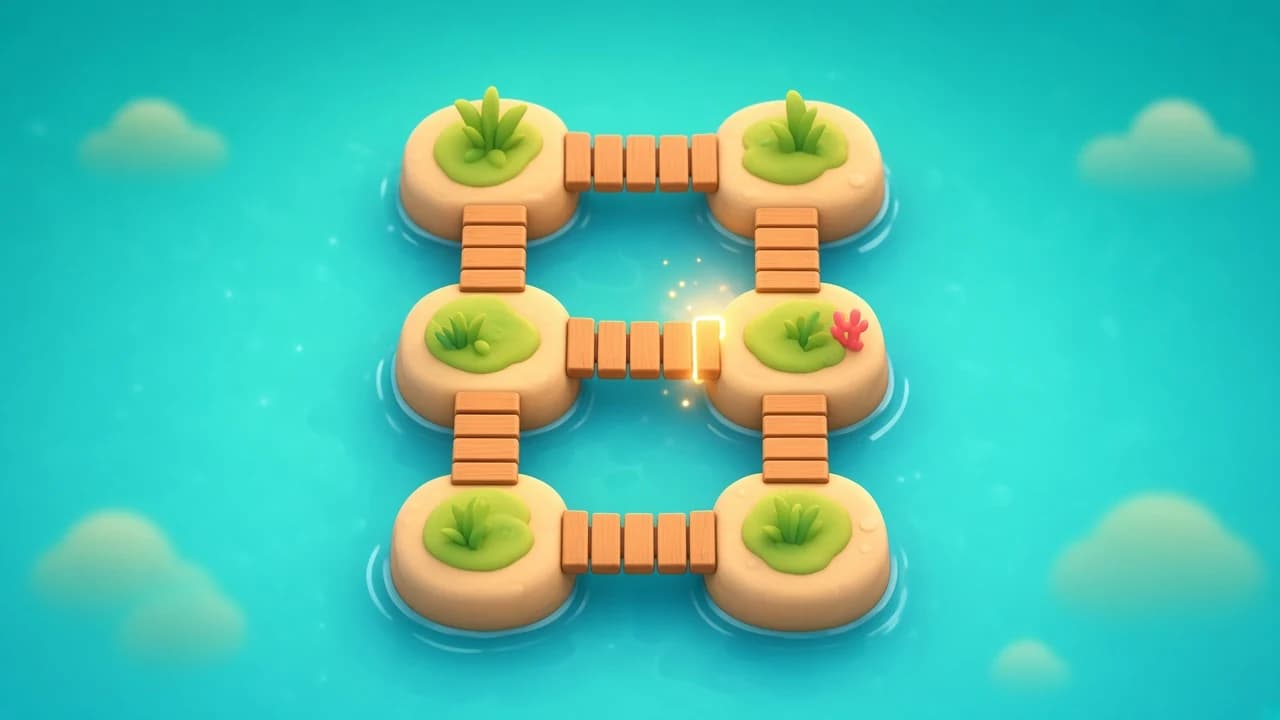
These hashi puzzle tips are for the point where you know the rules but keep getting stuck halfway. Hashi, also called Bridges or Hashiwokakero, rarely needs a guess. When you stall, there is almost always a forced bridge you haven't spotted yet. Below are the six checks I run, in order, every time I open a new board in Island Links.
Quick rules refresher: bridges run straight across or up and down, two islands share at most two bridges, bridges can't cross, each island's number is its bridge count, and the whole map has to end up as one connected group.
Hashi puzzle tips 1 and 2: count neighbours first
Before touching anything, look at each island and count how many neighbours it can actually reach. A neighbour is the nearest island in a straight line in each direction, with nothing blocking the way. Corners usually have two, edges three, open water up to four.
Each neighbour can take at most two bridges, so an island's ceiling is two times its neighbour count. That gives you two free moves:
- Full islands. If the number equals the ceiling, every bridge is a double. A 2 with one neighbour, a 4 with two, a 6 with three, an 8 with four. Nothing to think about.
- One short of full. If the number is the ceiling minus one, every neighbour gets at least one bridge. A 3 with two neighbours, a 5 with three, a 7 with four. You don't know where the double goes yet, but you can lay a single to each side right away.
The second one is the tip I wish I'd learned sooner. A 5 on an edge looks scary. It is actually three free bridges.
Tip 3: shrink the ceiling with small neighbours
The ceiling isn't always two per side. If one neighbour is a 1, it can only ever give you one bridge.
Say a 3 has two neighbours, and one of them is a 1. Its real ceiling is 1 + 2 = 3, so it is full: a single to the 1 and a double to the other side. Same idea with a 4 that has three neighbours where two are 1s. The ceiling drops to 1 + 1 + 2 = 4, so all of it is forced.
Neighbours that are already almost finished count the same way. A 3 that already has two bridges can only take one more from you.
Tip 4: never close a little group off
Every island has to join the main network, so any move that seals a small group with no way out is illegal.
- Two 1s next to each other can't be linked. They'd fill each other and sit alone.
- Two 2s can't share a double bridge, for the same reason.
- A 1 whose only neighbours are another 1 and a 3 must go to the 3.
- A 2 next to another 2 and one other island must send at least one bridge to that other island, because the double to the 2 is ruled out.
This rule gets stronger later in the game. Look at any cluster you've already built and ask how many open bridge slots it has left. If the answer is one, that slot has to be used, and it has to lead outward.
Tip 5: every bridge blocks something, so recount
A bridge is also a wall. Lay one across the middle of the board and the islands above and below it may lose a neighbour. A 4 that had three options might suddenly have two, which makes it full.
After every few moves, scan the islands near your newest bridges and count their neighbours again. Most of my "I'm stuck" moments end here, not with some clever trick.
Tip 6: use Mark, and play the size you can finish
Island Links has a Build / Mark switch under the board. Switch to Mark and drag across a gap you've ruled out, so you stop re-checking it. On a 15×15 map this saves a lot of squinting.
On size: under Type you can pick 7×7, 10×10 or 15×15, each in Easy, Medium or Hard. 7×7 Easy is good for drilling tips 1 and 2. Medium is where tips 3 and 4 start doing real work. 15×15 Hard is long, so have Undo ready. Solve exists, but a board finished with Solve doesn't count as a win, so I treat it as a last resort.
If you like this kind of puzzle
The same "never guess, find the forced move" feeling shows up in Fair Mines, a minesweeper where the board is built so you never face a 50/50. And if the connect-everything rule is what you enjoy most, Pipe Spin asks you to rotate tiles until every pipe forms one network, starting from the edges just like a hashi board.
One last habit: when a board finally clicks, start a new one at the same size straight away. The patterns stick much faster on the second run.
 Play Island LinksFree in your browser — no download.