Math Puzzle Games for Adults: 4 Free Ones That Aren't Homework
Math puzzle games for adults that feel like games: divide your way down to 1, merge tiles to 2048, count bridges and read minesweeper numbers. Free in the browser.
Published 4 min read
On this page
Most math puzzle games for adults are worksheets with a timer bolted on. These four aren't. Each one uses numbers as the puzzle itself, so you're planning and counting rather than racing to answer sums. All of them are free on physoe and run in the browser on a phone or a laptop.
I've ordered them from "most like arithmetic" to "least like arithmetic". The first one is the reason I wrote this post.
Down to One: the best math puzzle game for adults on the site
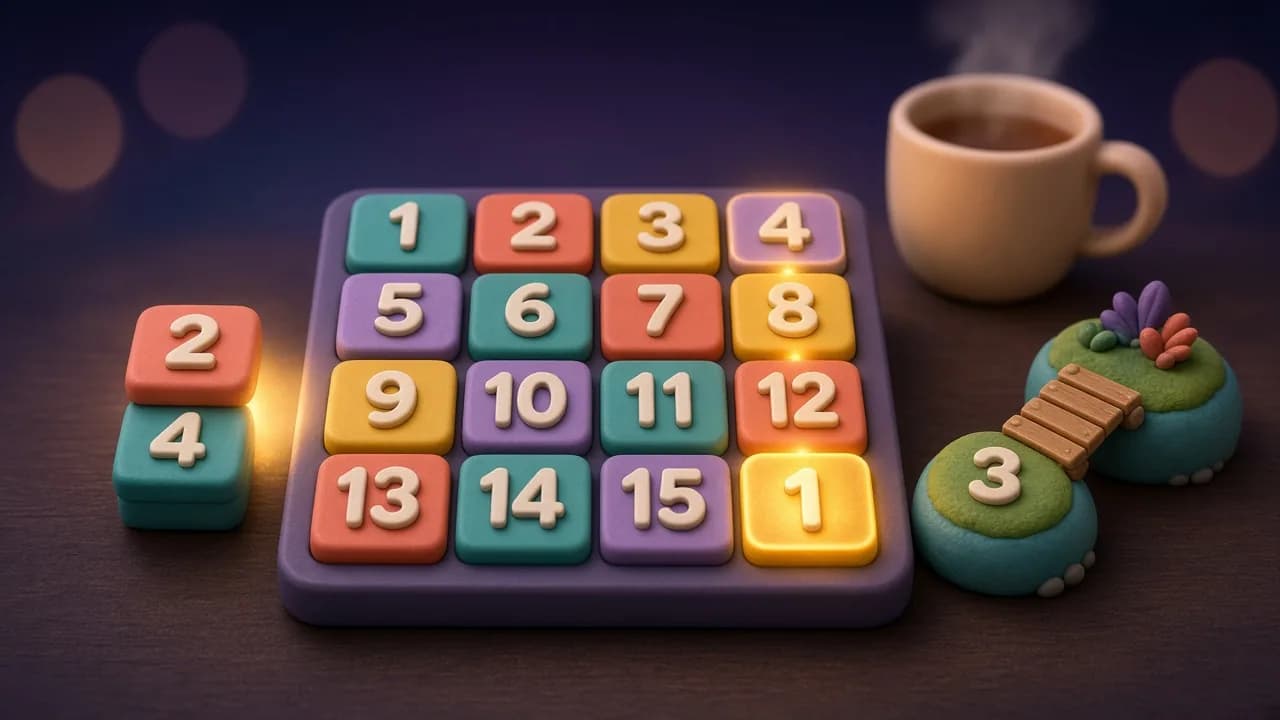
Down to One gives you a starting number and a 4×4 grid below it. You pick one number from each row, top to bottom. If it divides your number evenly, you divide. If it doesn't, it gets added. Land on exactly 1 and you get an ACE. Finish under 10 and it's a LOW. Anything else is High.
That's the whole rule set, and it takes about one level to learn. What keeps it going is that the level number is your starting number, and there are 256 of them.
Some things I found after a long evening with it:
- Every grid is the numbers 1 to 16, each used once, just shuffled. So you always know a 1 is in there somewhere. Picking 1 divides without changing anything, which makes it a free skip.
- Level 12 is a nice first "aha". Take the 1 in the top row to skip it, then the 12 in the second row. Done in two moves.
- Level 60 has exactly one route to 1, as far as I could find: 3, then 10, then 1, then 2. Everything else leaves you stuck.
- Not every level can reach 1. Level 17 is the first one where the best you can do is end on 2. When I counted, about three levels in ten had no ACE at all, so a LOW isn't failure. Sometimes it's the best result there is.
The habit that helped me most was working backwards. Look at the bottom row first. Your number going into that row has to equal one of those four numbers, because adding only makes it bigger. Then work out what gets you to that number.
The grid for each level never changes, so when a run goes wrong you can restart and try the other branch. Your best result per level is saved in the browser.
Double Tiles: doubling, not adding
Double Tiles is the 4×4 sliding game where two equal tiles merge into one worth twice as much. 2 and 2 make 4, 4 and 4 make 8, and you're trying to reach 2048.
The math here is quiet. You never calculate anything, but you're always thinking in powers of two: which tile needs a partner, and how far away that partner is. New tiles are usually 2 and sometimes 4, and you get no undo, so every swipe counts.
If you've played 2048 before, the corner strategy still works here. Pick one corner for the big tile and avoid the fourth direction. I wrote up the longer version in these number merge tips.
Island Links: counting that turns into logic
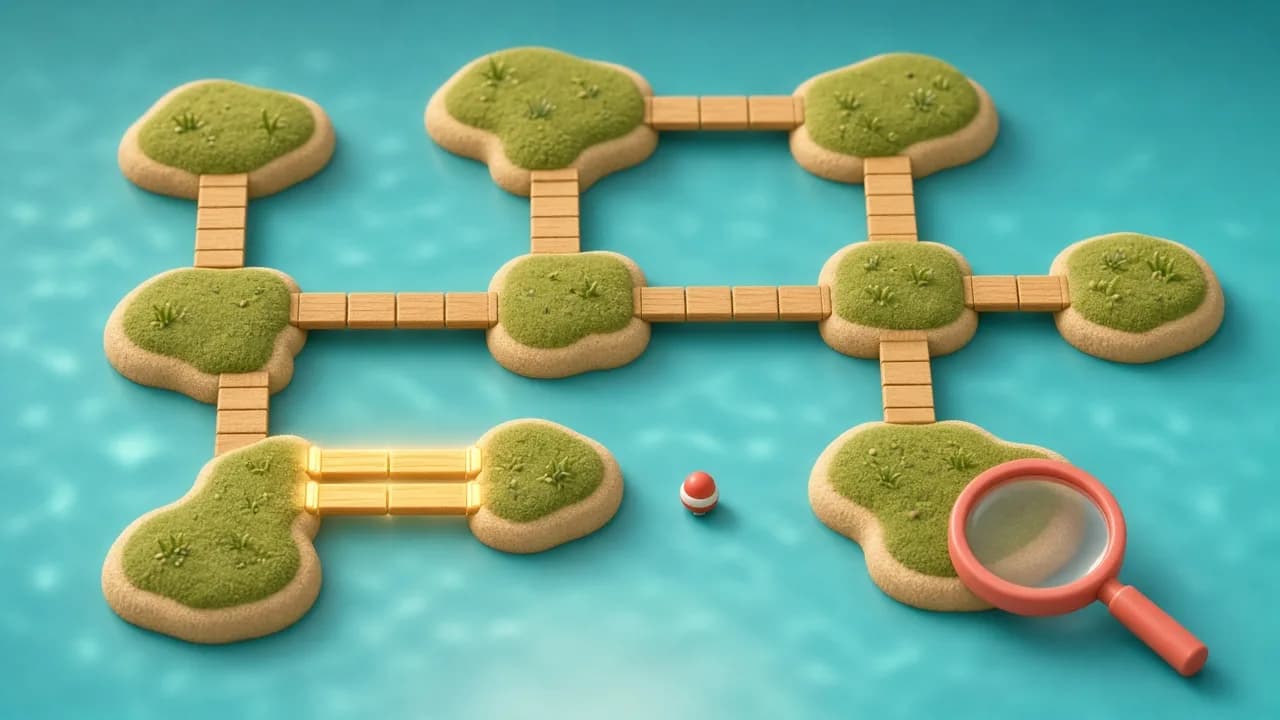
Island Links is a bridges puzzle, also called Hashi. Each island has a number, and you connect islands with straight bridges until every island has exactly that many. Two islands can share at most two bridges, bridges can't cross, and the whole map has to join up.
It sounds like counting, and at first it is. An 8 in the middle of the board needs two bridges in all four directions, no thinking needed. A 1 next to another 1 can't link to it, or those two islands would be cut off from everything else. After a few boards you stop counting and start reasoning, which is the fun part.
Start on 7×7 Easy. The 15×15 Hard boards are a proper evening. If you want more, there's a whole post of Hashi puzzle tips.
Fair Mines: the numbers do the work
Fair Mines is minesweeper with one change: it won't make you guess while a safe cell can still be proven. Every number tells you how many mines touch that cell, and the puzzle is reading those numbers against each other.
It's the least "mathy" game here, but it rewards the same kind of thinking. Two numbers that share neighbors can be subtracted, and the difference often tells you exactly where a mine is. When you do hit one, the board shows which cells were safe and Undo lets you look again.
There are four sizes, from Easy (8×8, 8 mines) to Brutal (10×10, 50 mines).
Which one to open first
- You like numbers and want a real puzzle: Down to One.
- You want something you can play half-asleep: Double Tiles.
- You want a slow, satisfying solve: Island Links.
- You want pure deduction with no luck: Fair Mines.
If you only try one of these math puzzle games, make it Down to One. Play level 1 to 12, then jump to 60 and see if you can find the single route.
 Play Down to OneFree in your browser — no download.